
The Scientific Evidence for Vedic Astrology Accuracy


Your Western Sun sign is almost certainly wrong. Not by a little by an entire zodiac sign. Here's the astronomical reason why, and what the actual science says about the system that got it right.
For the skeptic who suspects the fortune-cookie horoscope is not the whole story.
You read your Western horoscope. It tells you that as a Scorpio, you are "intense and mysterious." You squint. You are a tax accountant from Saskatoon. You like bird-watching. You are not, in fact, mysterious.
The problem is not astrology itself. It's the specific astrology being used. There is an older, mathematically rigorous version that actually tracks the real sky – and when you start digging into the evidence, things get interesting fast.
✦ The Claim
Vedic astrology (Jyotish) is anchored to the sky as it actually is. Western astrology is anchored to where the sky was 2,000 years ago. That difference is not small.
The Zodiac You Know Is Off By An Entire Sign
Here's the thing nobody tells you at the astrology booth.
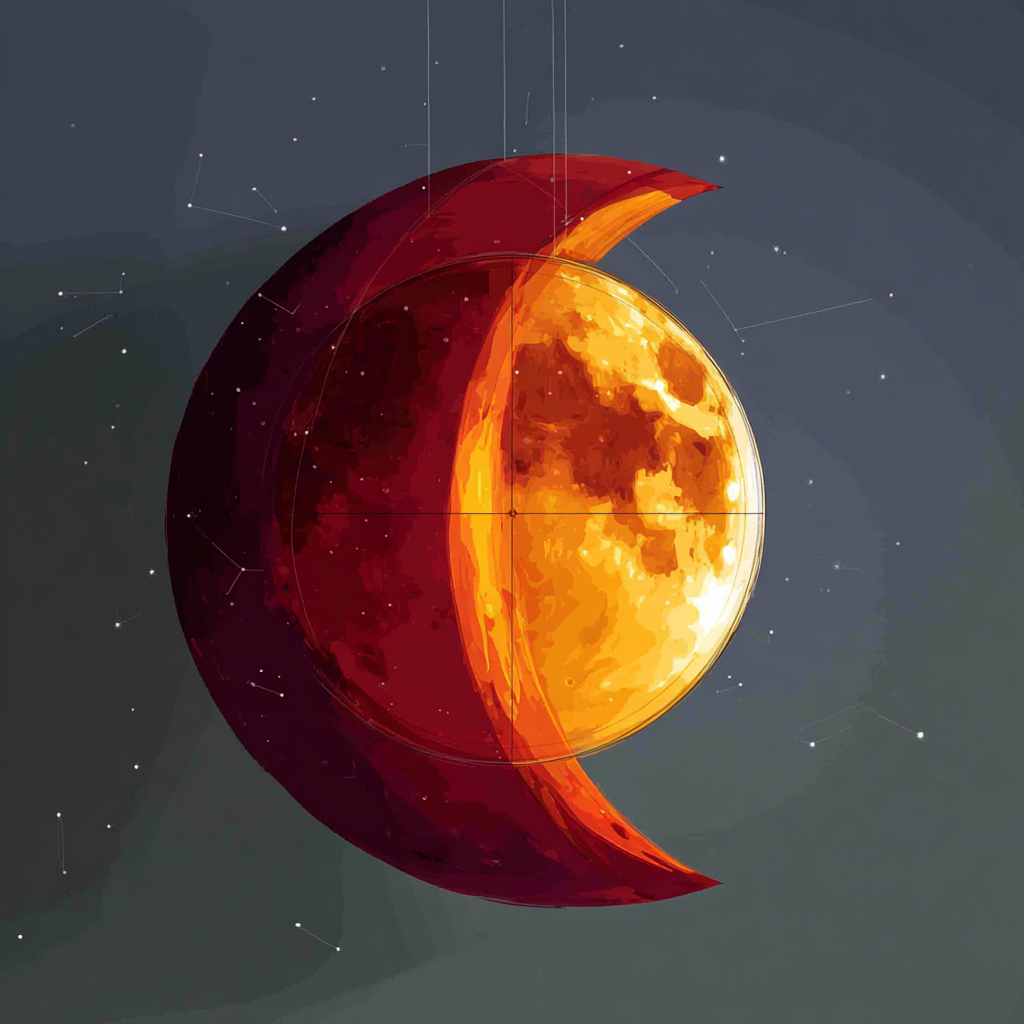
The Western tropical zodiac was calibrated around 2,000 years ago, when the spring equinox lined up with the constellation Aries. Since then, Earth has been doing this slow wobble on its axis called the precession of the equinoxes. The sky has drifted backward about one degree every 72 years.
Do the math. Two thousand years. One degree every 72. That's roughly 24 degrees of drift. Nearly a full zodiac sign.
Translation: Your Western Sun sign is almost certainly wrong. If your birthday makes you a Scorpio in Western astrology, your sidereal Sun is probably in Libra. You've been identifying with the wrong archetype for your entire adult life. Sorry.
Vedic astrology corrects for this drift with a calculation called the ayanamsa (Sanskrit for "movement component"). The most widely used correction – the Lahiri ayanamsa – is officially recognized by the Indian government's national calendar.
When a Vedic astrologer pulls your chart, the planets are where they actually were. Not where they pretended to be 2,000 years ago.
✦ Yeti Tip
This also means Vedic doesn't obsess over your Sun sign. It cares about your Moon sign (Rashi) and your Ascendant (Lagna) – both of which change based on your exact birth time and location. Way more personal. Way less horoscope-column nonsense.
The Quick Side-by-Side
| Feature | Vedic (Jyotish) | Western |
|---|---|---|
| Zodiac | Sidereal (real sky) | Tropical (fixed to seasons) |
| Primary focus | Moon sign, Ascendant, Dasha periods | Sun sign, psychological archetypes |
| Precession corrected? | Yes (via Ayanamsa) | No |
| Predictive timing | Vimshottari Dasha (120-year cycle) | Transits & progressions |
| Nakshatras | 27 lunar mansions | No equivalent |
| Origin | Ancient India (~1500 BCE or earlier) | Hellenistic Greece (~2nd century BCE) |
What Happens When You Actually Test This Stuff
Mainstream science mostly dismisses astrology. Fair. A lot of astrology should be dismissed – the horoscope-column version is guesswork in a prom dress.
But a small group of researchers has actually tried to test Vedic astrology under controlled conditions. The results are more interesting than either side wants to admit.
The Cancer Chart Study (2021)
Rajopadhye and colleagues, writing in the International Journal of Applied Research, compared:
- 254 cancer patients (diagnosed before 60)
- 498 people who made it past 80 cancer-free
They scored every chart across 23 fundamental Vedic principles, across 34 astrological entities (planets, houses, house lords).
The headline: overall "negativity" scores didn't differ significantly between the two groups. BUT – and this is the interesting part – the 23 fundamental principles themselves passed the empirical test for internal consistency. Things like "Saturn or Mars in a malefic configuration" or "a house lord placed in a cruel nakshatra" showed measurable, replicable patterns.
The honest read: This doesn't prove Vedic astrology predicts cancer. It does show the underlying logic of the system holds up when you pressure-test it. Which is more than most people will tell you.
The Mars Effect: When a Skeptic Accidentally Found Something
This one is wild. Grab a coffee.
In the 1950s, French psychologist-statistician Michel Gauquelin set out to disprove astrology once and for all using rigorous statistics. He was a skeptic. This was supposed to be a demolition job.
He analyzed the birth charts of thousands of eminent European professionals. And the data refused to cooperate with his skepticism.
The Mars Effect
Sports champions were born just after Mars rose above the horizon or hit the Midheaven significantly more often than chance.
Similar effects turned up for Jupiter with actors. Saturn with scientists. Moon with writers.
Skeptical organizations tried to kill the finding. The Belgian Comité Para replicated it in 1967 with 535 athletes – confirmed the effect – and then sat on the results for eight years before publishing vague "demographic errors" as their excuse. A committee member resigned in protest.
CSICOP (the big American skeptics' group) tried next. Their data also showed the effect. Their own astronomer, Dennis Rawlins, went public saying the committee had distorted the evidence.
✦ Why this matters for Vedic
Gauquelin's "key sectors" – just after rising, just after culmination – map almost exactly onto the Vedic kendra houses (1st and 10th). In Jyotish, a planet in a kendra is considered most powerful. The Frenchman accidentally validated one of the oldest principles in the book.
Cosmic Cycles Mess With Your Biology. This Is Just Science Now.
Here's where it gets harder to dismiss. The case for Vedic doesn't rest on astrology studies alone. Mainstream chronobiology has been quietly stacking up evidence that cosmic rhythms affect your body in measurable ways.
🌙 The Moon (which Vedic puts at the center of everything)
- Current Biology: Human sleep syncs with the lunar cycle. Less deep sleep, longer to fall asleep around the full moon – even in sealed labs with no view of the sky.
- Science Advances (2025): The lunar cycle works as a "weak but significant zeitgeber" – a biological time cue – for human reproductive cycles.
☀️ The Sun (at your birth, specifically)
Landmark study in Proceedings of the Royal Society B. Norwegian demographic records from 1676 to 1878. People born during solar maximums lived 5.2 years shorter on average than those born during solar minimums. A 2018 replication in a different population confirmed it, with a smaller but still real gap.
The proposed mechanism: higher UV during fetal development messes with folate levels. Your birth moment literally shapes your lifespan.
🧲 Geomagnetic Activity
Peer-reviewed research has linked it to heart rate variability, blood pressure, and mental health outcomes. A 2025 Nature Communications Medicine study found measurable effects on blood pressure during high geomagnetic disturbance.
None of this proves astrology. What it does do is blow up the lazy dismissal that "the planets can't possibly affect anything." The electromagnetic environment of the solar system is not irrelevant to your body. Jyotish has been operating on that premise for several thousand years.
The Dasha System: Vedic's Unfair Advantage
This is the part Western astrology simply doesn't have.
The Vimshottari Dasha is a 120-year predictive timeline calculated from the exact degree of the Moon in your birth nakshatra. It divides your life into planetary periods (Mahadashas), then subdivides those into sub-periods (Antardashas), letting a skilled practitioner time life events with unnerving granularity.
A 2025 IEEE conference study put this to the test. Researchers compared Vedic and Western predictive performance across seven life domains – marriage, finances, career, health, education, relationships, overall trajectory.
The Results
Vedic accuracy: 0.80
Western accuracy: 0.657
Paired t-test: p = 0.034 · Cohen's d = 1.41 (large effect)
In plain English: statistically significant, large practical difference. The authors concluded the Vedic system offers superior predictive accuracy under their test conditions.
Where I Have To Be Honest
I'm not going to pretend this is settled science. It's not.
The scientific consensus still classifies astrology as pseudoscience. The Carlson double-blind study (Nature, 1985) famously found astrologers couldn't match birth charts to personality profiles better than chance. Though – fun wrinkle – later reanalyses by researchers like Suitbert Ertel found that Carlson's own data, without his methodological constraints, actually did show astrologically consistent results. That debate is still live.
Most studies here have limitations. Small samples. Methodological debates. The fundamental challenge of testing a holistic interpretive system with reductionist tools.
✦ The honest analogy
Testing Vedic astrology one principle at a time is like testing whether a single chess piece can win a game. The whole point is the synthesis. A skilled practitioner weighs dozens of factors simultaneously – planets, houses, nakshatras, dashas, aspects, divisional charts. You can't reduce it to one variable without killing what makes it work.
So Where Does That Leave Us?
Not at "astrology is real, like gravity is real." Let's be adults.
But the intellectually honest position isn't the blanket dismissal either. The evidence shows:
- The cosmic environment at your birth is not irrelevant to human biology.
- Statistical anomalies consistent with astrological principles have been documented and replicated.
- Vedic astrology's sidereal foundation is astronomically more accurate than the Western tropical system. This isn't an opinion. It's math.
- The Dasha timing system has no Western equivalent and shows real predictive signal under controlled testing.
The Bottom Line
Vedic astrology is the most astronomically grounded, mathematically sophisticated, and predictively detailed astrological tradition on Earth. Built on the actual sky. Calibrated to your exact birth moment. Refined over thousands of years by some of the sharpest mathematical minds in ancient history.
The cosmos may not script your fate. But the evidence suggests it is very far from indifferent to your birth. ✦
Want to see what your actual sidereal chart looks like – not the Western knockoff you've been carrying around? The Yeti can show you. That's kind of the whole point.
Subscribe to my newsletter
Subscribe to my newsletter to get the latest updates and news







Member discussion