
Why Is My Vedic Moon Sign Different From My Western Moon Sign?

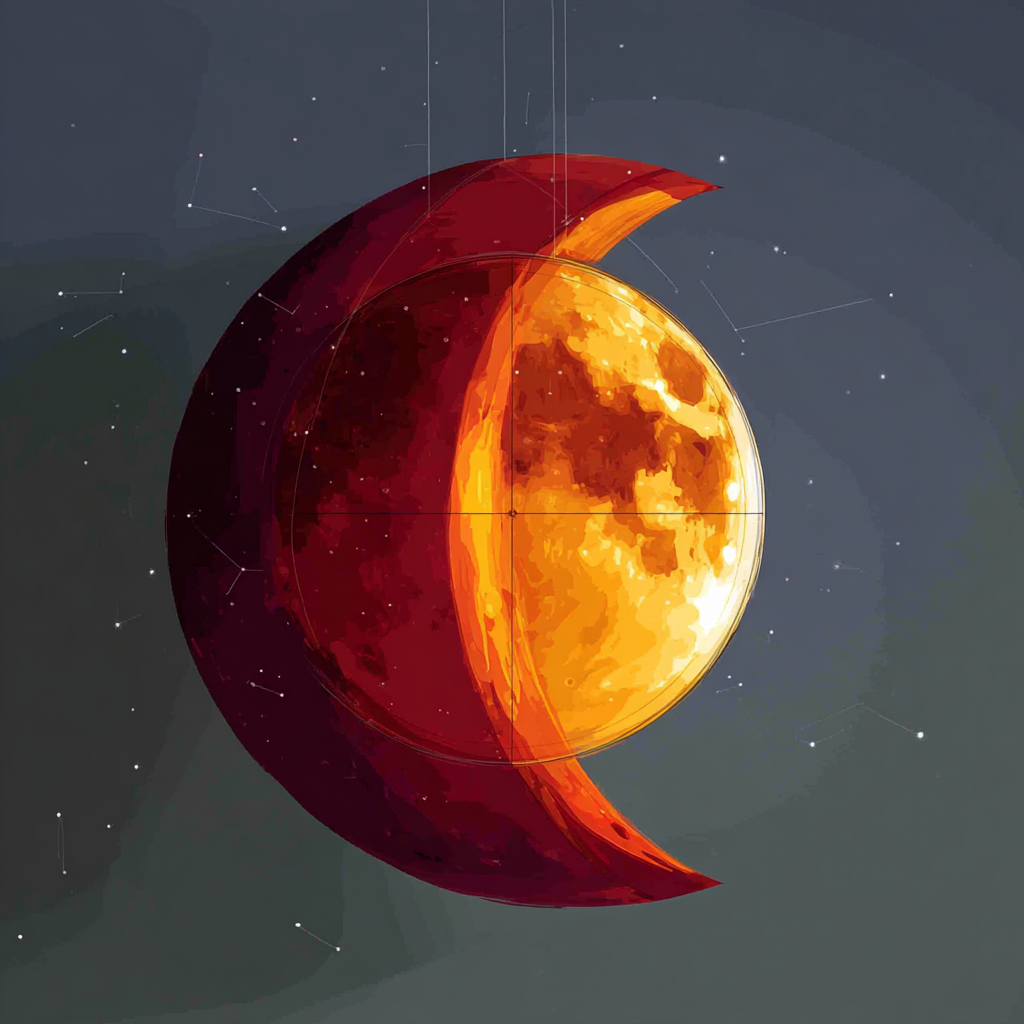
You ran your chart in a Vedic app and your Moon moved. Here's the astronomy behind it, and why your Vedic Moon is almost certainly the one telling the truth.
You spent years identifying as a Cancer Moon. Soft. Emotional. Homebody. It fit. Mostly.
Then you ran your chart in a Vedic app out of curiosity and the Moon shrugged and moved. Now it says Gemini. Or Sagittarius. Or Scorpio. And you are standing in your kitchen wondering which version of your emotional life is actually correct.
Short answer: the Vedic one. And the reason has nothing to do with mysticism and everything to do with a slow wobble in the Earth's axis that Western astrology never accounted for.
The Sky Has Moved. Western Astrology Has Not.
Here is the part nobody tells you at the horoscope column.
Western astrology uses the tropical zodiac. It was calibrated roughly 2,000 years ago, when the spring equinox lined up with the constellation Aries. Since then, the Earth has been doing a slow cosmic wobble called the precession of the equinoxes. The sky drifts backward about one degree every 72 years.
Do the math. Two thousand years. One degree every 72. That is roughly 24 degrees of drift. Nearly a full zodiac sign.
Vedic astrology, also called Jyotish, uses the sidereal zodiac. It is anchored to the actual fixed stars. When a Vedic chart places your Moon in a sign, that is where the Moon actually was at your birth, relative to the real constellations overhead.
Western astrology never corrected for the drift. Vedic corrects for it with a calculation called the ayanamsa. The most widely used correction, the Lahiri ayanamsa, is officially recognized by the Indian government's national calendar. Currently it is about 24 degrees.
So when your Vedic Moon shows up in a different sign, you are not looking at a different astrology. You are looking at the same Moon, placed against the sky that is actually there.
Why The Moon Specifically Hops Signs So Easily
Here is the technical wrinkle that makes the Moon feel especially disorienting.
The Sun moves slowly. It spends roughly 30 days in each sign. For the Sun to shift signs between the two systems, your tropical Sun has to be in the first 24 degrees of a sign. About 80 percent of people have a Vedic Sun one sign earlier than their Western Sun. Big effect, but predictable.
The Moon is faster. It moves through the entire zodiac in about 27 days, spending only around 2.25 days per sign. That means the Moon is almost always close to a sign boundary. If your tropical Moon was in the first 24 degrees of any sign, your Vedic Moon lands in the previous one.
And because the Moon is the emotional body of the chart, that shift tends to land harder than a Sun-sign swap. The Sun is your ego. The Moon is your inner weather. When the inner weather reassigns itself, you notice.
The Moon Is A Bigger Deal In Vedic Than You Realize
In Western astrology, the Sun sign is the headline. Moon is a supporting role. "I'm a Leo Sun with a Pisces Moon" and the Sun comes first.
Vedic flips that. In Jyotish, the Moon sign, called Rashi, is treated as the primary indicator of personality, mind, and emotional life. When a Vedic astrologer asks for your sign, they mean your Moon. Predictions, timing, compatibility, daily horoscopes – all of it is typically read from the Moon, not the Sun.
Why? The Vedic view is that the mind is what actually experiences life. The Sun represents the soul and vitality, which matter, but you do not live inside your soul minute-to-minute. You live inside your mind. The Moon is the mind.
So when your Vedic Moon sign turns out to be different from what you thought, it is not a minor correction. You just got handed the actual main character of your chart.
But My Western Moon Placement Felt So True
Valid. And worth sitting with honestly.
Here is what is probably going on. Western astrology, for all its astronomical drift, is genuinely good at psychological archetypes. The descriptions of a "Cancer Moon" or a "Scorpio Moon" are rich, literary, often poetic. If you read one that sounded like you, the resonance was real. You were not imagining it.
But there are a few things to hold at once.
First, those archetypes are general. They are written broadly enough that most thoughtful, introspective people can find themselves in several of them. That is not a criticism of the writers. It is how Sun-sign-style content works.
Second, the Vedic sign your Moon actually sits in has its own deep archetype, and it is often the one that explains the parts of you the Western description left out. A lot of people describe their Vedic Moon as feeling like the "why" behind the Western one. The Western description told you what you do. The Vedic one often tells you why you are wired that way.
Third, and this is where Vedic quietly outperforms, the Moon sign is only the opening move. Vedic then asks which Nakshatra your Moon occupies.
The Nakshatra Is Where It Actually Gets Personal
The 12 signs are a coarse grid. The 27 Nakshatras are a fine one.
Each sign is divided into roughly 2.25 Nakshatras, each spanning 13 degrees 20 minutes. Two people with Vedic Moon in Taurus can land in completely different Nakshatras (Krittika, Rohini, or Mrigashira) and read as entirely different human beings. One might be fiercely principled and sharp-edged. The next might be sensual and patient. The next, curious and restless.
Your Janma Nakshatra – the lunar mansion your Moon was sitting in when you were born – is also what Vedic astrology uses to time your life. The entire Vimshottari Dasha system, a 120-year predictive timeline that has no Western equivalent, is calculated from exactly that point. Your Moon's Nakshatra is not just personality data. It is the timing engine for your whole chart.
Western astrology has nothing that does this. That is not a dig. It is just a different tradition with a different toolkit.
So Which Moon Is The Real One?
Both Moons are real. There is only one Moon. The question is which zodiac you overlay on it.
If you want a chart that matches the sky as it actually is right now, corrected for 2,000 years of precession, tied to a predictive system that can time life events to the month, that is Vedic.
If you want psychological archetypes anchored to the seasons rather than the stars, that is Western, and it has real value on its own terms.
Most people who do the comparison end up quietly letting the Vedic Moon take over. Not because Western is wrong, but because the Vedic one fits with a precision that is hard to explain away once you have seen it. And the Nakshatra underneath it often names something about you that no Sun-sign description ever touched.
Curious what your actual Vedic Moon and Nakshatra say about your inner life? Ask the Yeti reads your full sidereal chart in plain English and will walk you through your Moon, your Nakshatra, and what they mean for how you feel and decide. No jargon, no 90-minute consults. Try it free at AskTheYeti.com and see which Moon actually sounds like you.

Curious what your actual Vedic Moon and Nakshatra say about your inner life?
Ask the Yeti reads your full sidereal chart in plain English and will walk you through your Moon, your Nakshatra, and what they mean for how you feel and decide. No jargon, no 90-minute consults.
Try it free at AskTheYeti.com and see which Moon actually sounds like you.
Subscribe to my newsletter
Subscribe to my newsletter to get the latest updates and news



Member discussion