What Is a Nakshatra in Vedic Astrology?

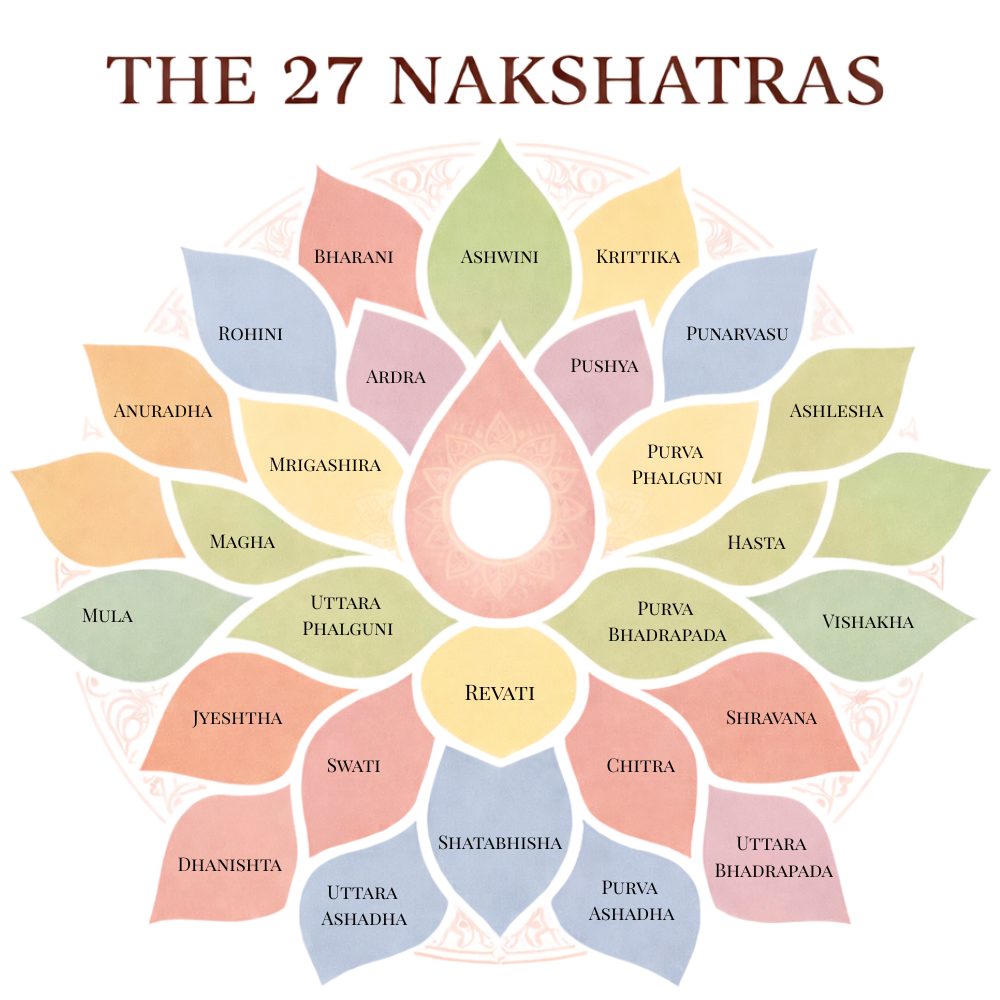
If you have looked at your Vedic birth chart and seen names like Ashwini, Rohini, or Magha, you were looking at your Nakshatra.
For many people, this is the moment Vedic astrology starts to feel very different from Western astrology.
The zodiac signs are only part of the system.
Nakshatras add another layer of precision.
What Is a Nakshatra?
A Nakshatra is a lunar constellation used in Vedic astrology.
While the zodiac is divided into 12 signs, Vedic astrology further divides the sky into 27 Nakshatras.
Each Nakshatra spans 13 degrees and 20 minutes of the zodiac.
These divisions are based on the Moon’s movement across the sky, not just the Sun’s position.
The word “Nakshatra” roughly translates to “lunar mansion.”
Signs describe the environment.
Nakshatras describe the texture within that environment.
Why 27 Nakshatras?
The Moon takes about 27 days to travel through the full zodiac cycle.
Ancient Vedic astronomers divided the sky into 27 equal sections to track this movement precisely.
Each Nakshatra marks one of those lunar stages.
This is one reason the Moon is so central in Vedic astrology.
The system is built around lived experience, perception, and emotional patterning, all qualities associated with the Moon.
Why the Moon Matters So Much
In Western astrology, the Sun often takes center stage.
In Vedic astrology, the Moon is often treated as more immediately relevant to daily life.
Your Moon sign describes your inner responses, your habits, and how you experience the world.
Your Moon’s Nakshatra refines that description.
Two people can share the same Moon sign.
Their Nakshatras can tell very different stories.
How Nakshatras Refine a Zodiac Sign
Let’s use an example.
If your Moon is in Taurus, Western astrology would stop there.
In Vedic astrology, Taurus spans parts of two different Nakshatras.
Each Nakshatra carries its own symbolic themes, planetary ruler, and psychological tone.
So even within the same sign, the expression can shift noticeably.
This is why Nakshatras often explain subtle differences between people who share the same zodiac sign.
What Each Nakshatra Contains
Every Nakshatra has several components:
- A ruling planet
- A symbolic image
- A presiding deity
- A specific motivation or life theme
These elements create a more nuanced interpretation than sign placement alone.
It is not just personality description. It is pattern recognition.
The zodiac sign sets the stage.
The Nakshatra defines the character.
What Are Padas?
Each Nakshatra is further divided into four sections called padas.
This creates 108 total divisions across the zodiac.
Padas add another level of refinement and connect to the Navamsa divisional chart.
For beginners, it is enough to understand that Nakshatras already offer more detail than sign placements alone.
Padas simply increase that precision.
Nakshatras and Life Timing
Nakshatras are not only descriptive. They are also functional.
Your birth Nakshatra determines the starting point of your Dasha cycle, which is the planetary period system used in Vedic astrology.
Dashas map out different life phases governed by specific planets.
This is one reason Vedic astrology is often associated with timing and prediction.
Nakshatras influence both personality and timing.
They are structural, not decorative.
How Nakshatras Differ From Western Subdivisions
Western astrology has smaller divisions such as decans.
However, Nakshatras are more integrated into the overall system.
They influence planetary periods, compatibility, and detailed chart analysis.
This makes them foundational in Vedic astrology, not optional extras.
How To Find Your Nakshatra
You need three pieces of information:
- Your birth date
- Your exact birth time
- Your birth location
Your Moon placement determines your primary Nakshatra.
Without accurate birth time, the result can shift, especially if your Moon was near a boundary.
Precision matters in this system.
If you want to see your Moon Nakshatra clearly and understand how it fits into your full chart,
you can calculate your complete Vedic birth chart inside the app.
A Simple Example: Same Sign, Different Nakshatra
Imagine two people with their Moon in Leo.
At the surface level, both may appear expressive, warm, and dramatic.
But Leo contains multiple Nakshatras. Each one carries a different ruling planet and symbolic tone.
One Nakshatra in Leo may emphasize leadership and visibility.
Another may emphasize performance, refinement, or public image.
Even though both people share the same Moon sign, their emotional motivations and life patterns can differ noticeably.
The sign gives the setting.
The Nakshatra reveals the motivation within that setting.
Do Nakshatras Affect Compatibility?
Yes, especially in traditional Vedic astrology.
Nakshatra matching is commonly used in relationship compatibility analysis.
This system evaluates how two people’s lunar constellations interact.
It looks at emotional rhythm, instinctive reactions, and long-term harmony.
While modern Western astrology often focuses on Sun sign compatibility, Vedic astrology places more weight on the Moon and Nakshatra alignment.
This creates a different compatibility framework entirely.
Common Beginner Misunderstandings
Many beginners assume Nakshatras replace zodiac signs.
They do not.
The zodiac sign still matters. The Nakshatra refines it.
Another common misunderstanding is thinking Nakshatras are minor details.
In Vedic astrology, they are foundational. They determine planetary periods and shape interpretation depth.
Nakshatras are not optional layers.
They are structural components of the system.
Putting It All Together
When people first encounter Nakshatras, they often realize Vedic astrology is built differently than what they are used to.
The 12 zodiac signs are only the outer framework.
The 27 Nakshatras refine that framework through lunar detail, symbolic themes, and timing systems.
This is part of why Vedic charts can feel more layered. They are working with smaller divisions and a Moon-centered perspective.
The sign gives you the category.
The Nakshatra gives you the nuance.
If you want to understand your own Nakshatra properly, you need your exact birth details and a correctly calculated Sidereal chart.
Once you see your Moon Nakshatra within the full structure of your chart, the system starts to make sense.
You can calculate your full Vedic birth chart inside the app and see your Nakshatra, Moon placement, and overall structure clearly explained.
See Your Nakshatra in Your Own Chart
Understanding Nakshatras conceptually is one thing.
Seeing how your Moon’s Nakshatra fits into your full Vedic chart is where it becomes personal.
Your Nakshatra is not just a label.
It shapes timing, emotional patterns, and life themes.
If you want to explore your full Sidereal chart, including your Moon placement and Nakshatra, you can calculate it using your exact birth details.
Subscribe to my newsletter to get the latest updates and news
Member discussion